Beautiful little BeastS: training tips for really really busy baby brains!
A Spaniel pup is a thing of beauty, obviously, but also can bring with them certain … challenges. And all the more so when they’re brainiac-clever and intent on learning everything about everyone and everything in the amount of time it takes a more ‘normal’ dog to learn to Sit!
Young Marlow is clever, bright, brilliant and utterly engaging. She has an older ‘sister’ who is perhaps less excited by the new arrival than the pup herself is. And she is quick to learn - so loves new games, tricks and challenges.
Trainer Olivia Turner has been enjoying working with her and has written some amazing notes that felt too good not to share more widely. Recreated in full here. Pick and choose which bits are relevant to your pup; or just digest the whole lot and marvel at the wonders of really understanding what’s going on in your brilliant dog’s baby brain :)
It was an absolute pleasure working with little Marlow during our session at House of Mutt. She’s a super girl, clearly very bright, switched on, attentive and confident; all the traits needed for the perfect dog. However, she is still very young and displays all the usual behaviours of a confident, intelligent puppy who needs the right education to ensure things go in the right direction. I wanted to run through all the puppy training basics in our session to get a feel for Marlow and the ideal exercises and methods that would suit her brain and how she learns. I also wanted to go over the training points you mentioned in her notes so hopefully this report will be useful for you at home.
The first thing to note about Marlow is that she’s the perfect stamp of a working cocker, both physically and mentally. It’s important that those behavioural needs and motivations are met or she’ll become frustrated, easily bored and will find her own entertainment which usually results in unwanted behaviours. She absolutely loves to work and be involved; she loves movement and short fast paced sessions which tap into that busy brain of hers. She’ll also flourish off of routine, consistency and predictability in all areas of life which can be the hardest things for us to implement if our schedules are a bit all over the place or there’s lots going on. Marlow’s intelligence is wonderful, but it means she’ll quickly learn undesirable things and will pick up on any training mistakes quickly if we allow her to - I think sometimes if they weren’t so clever or switched on, things would be much more straightforward! I know she’s settled in beautifully at HoM, she’s great with the other dogs, sits back and observes, and plays appropriately with the others. This will give her a big social education boost where she’ll be learning the etiquette rules and how to regulate her own levels of excitement or energy when needed.
To begin with in our session I took her outside and we spent some time going through some training basics such as lead work, recall, sit, down, navigating new objects (proprioception and confidence), patience, manners and being focussed and listening to whoever she’s with. Outside, Marlow is quite confident and independent – or at least she thinks she is. This confidence is ideal as she’ll be easy to take out and about but we must be careful that she doesn’t become overwhelmed accidentally and therefore worried. I noticed a couple of times in our session outside that she heard, smelt or saw things which she became a little anxious about and she didn’t know what to do. She would stand still and watch whatever it was (or scent their air if it was a smell) and took her time to assess the situation. If you’re with her when she reacts like this you can absolutely let her have that moment to think about it, give her around 5 seconds and then cheerily encourage her to carry on walking with you as if nothing is wrong. It’s important at her age that she learns how to confidently assess things but then look to you if she’s not sure. We want you to be the person she’s guided by and someone of value to her (absolutely necessary for a solid recall). So by allowing her to assess and think about it, then asking her to come with you, you’re allowing her time to process something (which encourages calm confidence) and you’re teaching her to follow you through your positive direction. In that moment you’re clearly telling her that it’s nothing to worry about and you’ve got her back and she doesn’t need to try and work out exactly what it is or what she needs to do about it because that’s your job. She’ll take direction from your attitude and behaviour in these moments and she’ll notice if you’re not there to help her. So be aware of how she’s feeling and what she’s responding to in the environment as she’s incredibly aware and is taking notes all the time about what’s going on and how she should behave. She’s at the age where her brain is very malleable and will be learning a lot about life and what’s what. So cash in on this age and really make the most of what you can do with her.
Lead Work
Marlow’s natural movement is very typical of a working cocker. They naturally find walking on a lead difficult and frustrating as they’re programmed to zig zag, move around you and scent the area for tracks and information. Starting Marlow off correctly so she finds lead walking easy and doesn’t learn to pull, will really set her up to be a delight to walk.
Loose lead walking is all about teaching a dog to have a true connection with you, so you feel like the lead is just a safety net rather than the only form of communication between you. I like a dog to be aware of me, paying me attention and not pulling on a lead, but also able to relax and enjoy their walk. A loose lead is one which has a smile in it and that’s what’s heavily rewarded.
This is my method to teach a loose lead to make sure it’s consistent in any environment and Marlow did very well at this:
- Reward a loose lead! I use my voice to reward (lots of “good girl”) and also back that up with food as another reinforcer. Marlow is still quite new to the rules of the lead so I covered the basics of walking with me and using ‘mini recalls’ to encourage her to come with me rather than going off on her own. This teaches her to listen to me rather than rely on lead pressure to tell her what to do. If she came with me and there was a smile in the lead, she was rewarded.
- If she pulls, slow your walking speed down and resist the pull but try not to pull back or tug on the lead. I use my voice to remind a dog to walk slowly at my pace so they don’t pull and learn to maintain that smiling lead. You can use the word “slowly” to remind her to walk with you than against you. When she turns to you and offers a smile in the lead again, reward and carry on. Back this up with a food reward once she’s walked nicely a little further. You can also use those mini recalls here too. Marlow was very responsive to my voice and reconnected with me (and thus stopped pulling) very quickly. Her pulls at this age are very minor and more like a ‘drift in another direction to sniff something’ so easily changed. You can start implementing a ‘go slower’ cue like “slower” (said in a slow, low tone so it sounds distinctive) but it’ll take time for her to truly understand what this means.
- If she lunges, pulls too hard or becomes completely distracted – Stop walking and if needed, take a few steps backwards without turning around. This immediately deletes a strong lunge and reconnects a dog with you. From here it’s much easier to calm things down and re-start the walking. It’s also a very clear signal to the dog not to suddenly lunge for things when they’re attached to you. Marlow wasn’t an almighty puller at all but she’s keen to do the typical cocker zig zag and will start pulling to get to a sniff. This little ‘stop and re-set’ tip can be very useful for those scenarios.
- Change direction – To keep Marlow interested in you and focused, change direction every now and then. Use your voice first to let her know you’re changing direction (I tend to say “this way”) and then move your body. If she wasn’t paying attention, then she’ll feel the lead pressure engage and the second she walks with you, the lead pressure drops off again. Using your voice, then body, then lead pressure means she has to start paying attention properly and think for herself. Change the direction just as you notice her disengage from you slightly or if she's looking to pull to a sniff. This is great to add in some interest to the walk that comes from you and she’ll enjoy moving with you than searching for her own amusement and interest in the environment. We also want Marlow to learn that when she’s attached to you there are limits to what freedom she has and what she can access, so keeping things interesting will prevent her from feeling sour about being on a lead and not wanting to work with you.
- Speed changes - Movement definitely gets her attention and you can go from being a very boring person to an exciting one by simply speeding up and slowing down. Offer her lots of praise when she’s staying with you and adjusting her speed to match yours. Marlow loved this as it meant running a little together, then stopping, changing direction, speeding up and slowing down. I also integrated some sits and downs along the way so you’re running through all the behaviours she knows (and enjoys) whilst teaching her how to enjoy offering a loose lead.
- Automatic sits - The aim here is that when I stop, she stops and automatically sits for me, then is rewarded. Initially she needed me to ask her to sit but after a few repetitions she was automatically offering a sit without me asking. Her breed is naturally very good at this due to their desire to work for people, looking at you and offering you their complete focus comes easily – we just need to reinforce it!
This is also excellent at teaching a dog to not jump up because nothing good happens when they jump up. Simply wait for her to sit down and look at you, then offer her attention and engagement, or a food reward. Practice these anywhere you like and if she’s being bouncy, don’t engage with her until she’s got 4 paws on the floor.
- Mini recalls – A very easy excise where you’re teaching Marlow to respond quickly to her name and offer you her attention. As you’re walking along, call her name and immediately reward her for looking at you. You can reinforce/ reward by either hand feeding or throwing the food out for her to find. The latter is a great way of building excitement and value to yourself as you become the deliverer of good things! This creates a strong foundation for a solid recall later on.
- Heel. I tend to keep heel as a specific command that means ‘walk next to me until I say otherwise’. There needs to be an end cue for heel as well for brains like Marlow’s really want clear rules! So the start cue would be “heel” coupled with a visual cue of hand tapping your thigh (or similar). When you don’t need her to heel, then say “ok” or “free”, whatever word you like. Use plenty of rewards when she’s heeling and walking next to you and then stop the rewards when you’ve released her from that. I would start practising this at home around the house and garden where the environment is controllable and do short bursts of heel followed by play with a toy. Eventually this can be done outside on walks and it’ll be a behaviour that works best when she’s off the lead and you need her to walk with you for a while. I find clever dogs like her become frustrated with heel when they’re on a lead as the presence of the lead already means ‘walk with me’ and that’s what we teach. So aim to use heel properly later when she’s established with her recall off lead and reliable. A good example is recalling to heel and walking past other dogs, people or anything you need to navigate under control before letting her zoom off again on those circling cocker fly by’s!
A Note on Rewards
At the moment Marlow is quite food motivated which is perfect for the training she needs to do at this age. However I tend to find with most working breeds that there comes a time when the food isn’t overly valuable anymore and we need to find something to be that great reinforcer and motivator for them. Ideally we want you to be that great reinforcer and to harness her desire to work for you and do things with you. Otherwise she will find other things that reinforce her which tend to be all the things you don’t want (like running off, eating things she shouldn’t, taking items, etc). So do make a big fuss of her when she gets things right with physical praise (she loves a rub and a fuss) and verbal praise (lots of “good girl”, etc). She’ll respond well to this and it shows her that you’re paying attention, value her efforts and will help strengthen your bond and connection. She’ll trust you more in the training the more you engage directly with her which pays off big time later on.
As you progress with her training, make sure that you’re noticing she’s offering you the behaviours because you’ve asked and she’s willing to work with you. You’ll be rewarding her a lot all the time yourself (which you can back up with food and play) but I want you to start noticing that she’s willing and responding positively to your praise and engagement. If she isn’t then you’ll find it much harder when she’s older to reestablish any boundaries that go awry during adolescent.
Food rewards – use a combination of treats that range from being fairly valuable to VERY valuable. Then you can reward her level of effort accordingly and always be encouraging more from her.
Easy behaviours – reward with the lower value treats like training biscuits. These are behaviours she already knows or is fairly established at, but you still need to back up with a food reward.
Hard behaviours – reward with a much higher value reward like sausage, chicken, pate, etc. Something she REALLY likes and will work hard for (as well as you of course). Save these rewards for times when you’re teaching her something hard and she needs to put in more effort or when you need to motivate her more. Once she becomes more established at these behaviours, you can lower the value of the reward so you’re encouraging her to offer more and genuinely think about what behaviours pay or earn the jackpot!
General Obedience and Manners
She’ll be practicing these daily at HoM just through the normal day to day things which require her to listen, have patience, go to a bed, sit or lie down when asked and have good manners through doorways.
I found her excellent at these and we didn’t need to spend lots of time running through things like sit or lie down. What she can start practising more of are behaviours that test her impulse control which will help instil those boundaries and listening skills. Some examples are:
- Wait. The aim here is that she has to wait to get the food until you release her. I used a lead to ensure she couldn’t leap after them immediately or you can gently hold her collar. You don’t need to use a verbal command just yet, though we’ll start to incorporate “wait” in later. She’ll stare at the food initially and will try and get it. She’s obviously prevented from doing so because of the lead or collar, so wait until she looks at you and offers you eye contact. When she does, immediately release with lots of praise! She’ll catch onto this quickly: looks at you = access to the food.
You can start to add in some verbal commands here, so use “wait” to indicate ‘wait until I say’, then “find it” when you release her. Both these commands can be useful in other situations, just make sure that you differentiate between ‘wait’ and ‘leave it’. The latter means don’t ever touch, while wait means pause.
- Leave it. This command is a very helpful for a variety of situations as it means ‘don’t touch and you can’t have it’. Think of using this for forbidden items, those that could be dangerous or items that are yours and not hers. Start with her in a sit and have 2 different sets of treats to hand (some high value and some low value). Put some of the low value food (like biscuits) in your hand and hold them out towards her (about halfway between you and her) with your hand closed around the treats. She’ll sniff or paw your hand to get the food but she’s not allowed to have them. When she moves her nose away and stops trying to get them, say “yes” and reward her with a piece of higher value food from your other pot. Don’t give her the food that was in your hand as this is the ‘leave it food and leave it means don’t touch!
Repeat this a few times and start to use the command “leave it”. As she moves away from your hand or doesn’t try accessing the food, say “yes” and reward from the other treat pot.
Now take this to the next level by holding out the closed hand, say “leave it”, then open your fist so the food is visible. If she tried to grab the food, close your hand again to prevent her getting it. Ask her again to leave it and test her by opening your hand. If she leaves it, lots of praise and reward her from the other pot.
Keep progressing with this by offering out an open hand already so the temptation is greater. If she goes to take them, close your hand.
The next big step is to place the forbidden food on the floor. Be ready with your hand to cover the food if she goes to take it and follow the same steps as above.
This will be a good introduction to what “leave it” means and the big rule that everyone must follow in the house is that if you ask her to leave something it means she can never have it. So don’t mix up a ‘wait’ with a ‘leave it’.
- Spell her name. This is a fun game that tags on the back of leave it training where you spell out her name in treats on the floor next to her. She’s not allowed to eat any of these and it tests her understanding of leave it. Start with just a few pieces and then progress to a letter. Then progress to multiple letters and finally her name. Remember to collect the treats up again before rewarding her with a higher value treat from the other pot! She’ll find this difficult at first so make sure she understands leave it before moving onto this game.
There are other impulse control games that can be done so if you’re stuck for ideas let me know and I can run through some more for you.
Recall
The mini recalls I mentioned earlier are the starting blocks for a good recall and I think Marlow will be easy to train for a recall as she showed good responsiveness to her name and enthusiasm to come back during our session.
Start this training at home where the environment is safe and controlled and do short, fun and exciting recall practise sessions so she doesn’t get bored or tired. Remember we want her to always find it very fun and rewarding to come back to you so don’t train this if you’re not feeling energetic or exciting yourself.
- Choose a recall command. Most people like “here” or “come”. Whatever you choose make sure everyone uses it so it’s consistent for Marlow.
- Use lots of high value food for the recall to build that motivation and if she shows an interest in toys, then you can use toys as the reward instead.
- Only do easy recalls at this age so you’re not too far away and it’s easy for her to get the answer right. Test her occasionally by recalling when she’s busy (e.g., while she’s sniffing something). She’ll find this very hard at first, so really ramp up the rewards for this if she responds.
- If she ignores you, go and fetch her as it’s important she doesn’t learn that ignoring you is an answer as this quickly becomes valuable to the dog where they can run off and have their own fun. Take care that you don’t spark off a ‘chase me game’ and make her aversive to you coming over while she’s doing something she considers more fun. So think of this as a gentle puppy reminder that you were talking to her and she needs to come along.
- Play Marlow pingo pong between a few people and move around the house or garden as you do so. Make yourselves exciting and fun to catch up with so she has a VERY FUN time recalling to you.
- Consider whistle training. A lot of working breeds respond very well to whistle training as the sound is the same every time and it always means the same thing. It’ll also cut through any other environmental ‘noise’ and is easily heard and processed by an already preoccupied or busy brain.
If you need help getting started with whistle training, let me know and I can advise.
If you feel things are going well at home, then you can practice recall in safe places on walks and test her understanding around real world distractions. Recall is something that takes a long time to truly become consolidated and reliable. It takes practise around a lot of different real world distractions and it won’t be fully consolidated until she becomes an adult dog. So be prepared to always be working on her recall and making sure she’s listening and responding to you. The key to a good recall is to keep it fun and rewarding for the dog and if she’s toy motivated, playing games like fetch really help strengthen that positive association with coming back to a person.
Enrichment
It’s important for young dogs to have a variety of exercises that stimulate them mentally and physically. Marlow will flourish with plenty of fun physical exercise, but she also needs calming activities for her brain to ensure she’s not wired all the time and can truly settle and relax. Dogs that only ever do a lot of running, chasing or high energy activities will often be overtired, irritable when they should be sleeping and will struggle to settle and make good choices. So I ended our session with the perfect calming exercise to relax her brain and body and offer her an appropriate end to all that excitement.
Food searches are always useful to do outside (or inside), be creative and use different surfaces to encourage her to use her nose and find all the pieces. I used a log pile in our session where I scattered a few treats in and around it to create a perfect ‘sniff and find’ zone for Marlow to enjoy. She went into full cocker mode here and thoroughly enjoyed using her nose and brain to sniff out all the pieces. This also doubled up as a movement or proprioception activity where she’s learning to navigate different obstacles, surfaces and working at different heights. Food searches can be done literally anywhere and everywhere and are the easiest thing to incorporate into a walk or as a brain activity at home. You can also use these moments to help her find the pieces, so point things out to her and encourage her to ‘find it’. Your involvement will help her see you as a partner and someone who is the deliverer of wonderful things!
Refer to my enrichment guide for more information and ideas.
Marlow and Kajsa
It can be common for the older dog to not be as strict as you’d like them to be when it comes to tolerating the annoying new puppy that’s hanging off their ears or constantly wanting to play. Some dogs are naturally very good at this and others just don’t tell them off quite enough. The puppy can soon learn to really push the boundaries and won’t listen to any reprimand or correction from the older dog. This is where you need to step in for Kajsa and remind Marlow to listen to how another dog is feeling and not be a pest. If you need to, create a barrier between them so Kajsa can sleep and Marlow learns that she can’t always have access to her and do what she wants (another necessary life skill). A barrier can simply be putting one dog away or having them in separate rooms.
If Marlow is full of energy and won’t sleep, then give her something to do and encourage her to think about settling. Refer to the enrichment guide!
House Boundaries
It’s important that Marlow learns that there are parts of the house that she can’t go in or she can’t have access to all the furniture, etc. Creating a small house environment for the young puppy means you can control where they can go and what they can do easily which helps them learn effectively what the rules and boundaries are. As they get older and are more trustworthy, you can give them access to other areas of the house and leave them unsupervised. I can easily see where Marlow will find furniture part of her playground and will have great fun leaping over things and jumping about. Making sure that she has an outlet for this energy is the main thing, so she needs to have the right amount of exercise outside where she can run and jump and have some proper fun. This will help reduce moments of ‘zoomies’ inside where ideally you’d like her to settle and relax.
She’ll need clear ‘bed’ areas where she can go and sleep that are her space. You can ask her to go here when you know she needs a nap and it might be helpful (if you haven’t already) to make these contained (like a pen or crate) so she can’t start mooching around and wake herself up again. This also gives you chance to do other things in the house without having to constantly watch her because you can’t maintain boundaries if you can’t see what she’s doing.
If she tries to get on furniture then tell her that’s not allowed and make her get down. The easiest way is to pre-empt when she’s thinking about doing it and catch her then before she actually gets up there. So if she’s free around the house and looks like she’s thinking of jumping up without your permission, remind her that’s not allowed and ask her to go somewhere else, e.g. her bed to settle or give her something else to occupy her mind if she’s very awake and needs some brain stimulation.
Marlow loves rules and she’ll want you to be good trainers where your timing is spot on and you’re quick to encourage and praise or remind her what’s not ok or that wasn’t the right answer. It won’t take her long at all to learn a new behaviour and this is the age she’ll fly through the training. The harder part will come later when she creeps into adolescence and won’t rely on you as much for guidance or direction. So establishing those all important boundaries now and becoming a very valuable person in her eyes is greatly important and necessary for future training to be successful. She’s such a super girl and I thoroughly enjoyed working with her!
I hope this report is useful to you and if you have any questions don’t hesitate to get in touch with me.
Best wishes,
Olivia
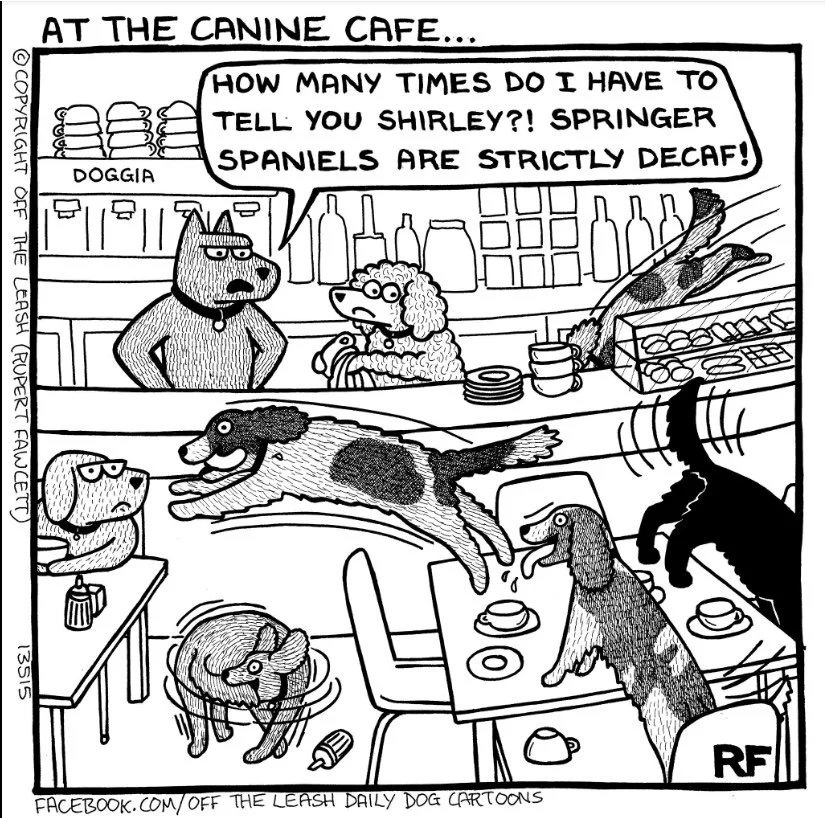
Finally, the brilliant Off the Leash cartoon below -which feels apposite!